"...a revival of the Glass-Steagall Act that separated commercial and investment banking, or the so-called “Volcker Rule” barring investment banks from proprietary trading and running hedge or private equity funds, would have unintended consequences. “This pressure to break things up is only going to increase these interconnections and potentially make the system more fragile,” he said.
The priority should be to make market infrastructure more robust, particularly by improving the bankruptcy resolution regimes..."
Thursday, March 25, 2010

Tuesday, March 23, 2010
US growth from FT

"...From the trough of the 2002 recession – as measured by the National Bureau of Economic Research – to that in 2009, real US gross domestic product grew on average only 1.7 per cent a year. The Federal Reserve Bank of Atlanta calculates that only straight after the second world war, when the economy shrank in real terms, has growth been weaker in any trough-to-trough period since 1933..."
Tett: Municipalities in swaps
"...The reason is derivatives. Earlier this week, the City of Milan announced that it is suing Deutsche, UBS, JPMorgan and Dexia, for allegedly misleading the city on swaps that adjusted interest payments on some €1.7bn ($2.3bn) of deals. The allegations, which the banks deny, will start in May.
Meanwhile, on the other side of the Atlantic - if not cultural spectrum - another battle has recently played out in relation to bonds and swaps arranged by JPMorgan for Birmingham county, Alabama. Last year, JPMorgan agreed to pay a $25m civil fine, make a $50m payment to Birmingham and forfeit $647m in termination fees linked to swaps deals. This came after the Securities and Exchange Commission accused JPMorgan of malpractice (a claim that the bank neither admitted nor denied on settlement)..."
Meanwhile, on the other side of the Atlantic - if not cultural spectrum - another battle has recently played out in relation to bonds and swaps arranged by JPMorgan for Birmingham county, Alabama. Last year, JPMorgan agreed to pay a $25m civil fine, make a $50m payment to Birmingham and forfeit $647m in termination fees linked to swaps deals. This came after the Securities and Exchange Commission accused JPMorgan of malpractice (a claim that the bank neither admitted nor denied on settlement)..."
Hughes on Lehman
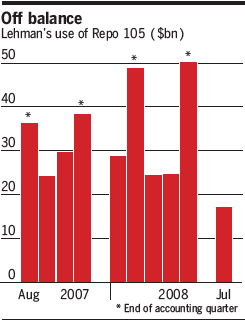
Banks use repurchase agreements, known as repos, all the time for short-term financing. One borrows cash and gives the other securities, such as government bonds, as collateral. Both agree to unwind the arrangement on a set date. The deals, which usually run only for days or weeks, are accounted for as financings, and remain on the books with banks recording an asset – the cash – and a matching liability in the promise to buy back the collateral.
Lehman’s 105 was different – instead of handing over securities equivalent to the cash it received, the bank gave more than was necessary. The point was to exploit a loophole allowing such over-collateralised deals to be accounted for as true sales. Lehman then reported its obligation to repurchase the securities at a fraction of the full cost, and used the cash it had received to pay off its liabilities, thereby “shrinking” its balance sheet.
Use of Repo 105 spiked sharply at the end of each accounting quarter – more so in 2008 as pressure grew on Lehman to reduce its leverage – and fell just as dramatically soon after the new accounting period began, as deals were unwound.
Copyright The Financial Times Limited 2010. You may share using our article tools.
Wednesday, March 17, 2010
Subscribe to:
Posts (Atom)
